Long hours at a keyboard, a scanner, or a checkout line can turn a quiet wrist into a loud problem. The right support should slip on, stay put, and let you keep typing, stocking, or assembling without a constant ache in the background. The picks below cover working setups, from typing all day to athletic loads.
How The Shortlist Stacks Up

CarpalAid Version 2 Carpal Tunnel Pain Relief Patches

FUTURO Compression Stabilizing Wrist Brace (Small/Medium)

FREETOO Carpal Tunnel Wrist Brace Night Support (Right, Medium)
FREETOO Carpal Tunnel Wrist Brace Night Support (Left, Medium)

ZOFORE SPORT Carpal Tunnel Wrist Brace with Metal Splint Stabilizer (Right, L/XL)

Tiger Paw Gymnastics Wrist Supports (Sold in Pairs)
Typing through a deadline feels different when there’s nothing strapped to your wrist. The CarpalAid Version 2 uses an adhesive patch approach instead of a sleeve, sitting flat against the skin over the median nerve area with no compression band and no thumb loop to fiddle with. For office workers logging long hours at a laptop or front-desk setup, that near-invisible profile matters: nothing bunches under a keyboard sleeve, and the patch stays out of the way during phone calls or mouse clicks.
The pack format is geared toward repeated use over weeks rather than a single injury event. You peel, apply, and replace as the adhesive loosens through handwashing or sweating. Compared to the FUTURO Compression Stabilizing Wrist Brace reviewed below, this is a different philosophy entirely: minimal coverage, targeted placement, and a tradeoff in structural support.
Everyday Wins
- Adhesive-only design keeps the patch flat under shirt cuffs and watch bands, useful for client-facing roles where visible bulk reads as awkward.
- Targeted placement over the nerve area avoids the all-wrist squeeze that compression sleeves create, which some users with sensitive forearms prefer.
- Multi-pack count (30) supports a steady daily routine without frequent reordering, helpful for shift workers and remote employees alike.
- No straps mean faster on-and-off transitions between typing sessions and breaks, with nothing to re-thread or tighten.
Things To Consider
- Adhesive strength varies with skin type and humidity; in sweaty warehouse or kitchen shifts, edges may lift sooner than expected.
- Unlike the ZOFORE SPORT brace below, there’s no rigid stay, so the patch won’t restrict motion during heavier tasks.
Who Will Love This
Keyboard-heavy professionals who want subtle, low-profile wrist support without committing to a bulky brace through every meeting.
Skip It When
You do heavy lifting or assembly line work; the FREETOO Night Support brace or ZOFORE SPORT model offers more structural hold for that profile.
The FUTURO Compression Stabilizing Wrist Brace has been a staple on the hand-and-wrist shelf for years, and its three-strap layout explains why. You set the base wrap, dial in compression across the wrist, then lock the third strap over the top to keep everything from sliding mid-shift. For typists, retail associates on registers, and warehouse pickers, that adjustability is the draw: one brace covers a wide range of pressure preferences across a workday.
The breathable fabric and open-finger design let your hand keep working without trapping heat, which matters more than it sounds during a summer commute or a back-of-house kitchen stretch. Compared to the CarpalAid patch above, this is the more traditional choice: a sleeve you feel, but one that still lets fingers move freely for keyboard and scanner work.
Real-World Strengths
- Three-strap system lets you tune compression as swelling changes through the day, useful for shifts that span eight hours or more.
- Open-palm construction leaves fingers free for typing, scanning, and gripping without removing the brace.
- Breathable material reduces the sweaty-fabric feel that drives some users to abandon braces by mid-afternoon.
- Slip-on design works over either hand depending on orientation, which simplifies shared workplace first-aid kits.
Worth Noting
- Sizing runs specific: the Small/Medium designation fits a narrower range than generic “one size” braces, so measure your wrist before ordering.
- Compression straps need occasional re-tightening during heavy use, and the hook-and-loop material loses grip over many wash cycles.
Key Specs
Made For
Full-day typists and register-based retail workers who want adjustable compression and the freedom to keep their fingers moving.
Consider Something Else When
You need overnight immobilization; the FREETOO Carpal Tunnel Wrist Brace Night Support is built specifically for that rest position.
Working hours matter, but sleep is where wrist inflammation often resets, and the FREETOO Night Support brace leans into that window. The anatomical S-shape curves along the palm and wrist to hold your hand in a neutral position, reducing the curling that flares symptoms overnight. For right-handed workers logging keyboard or mouse strain by day, the brace keeps the hand from folding into a fist while you sleep.
The medium sizing covers a common adult range, and the construction is meant for stationary wear rather than active grip. Pair it with the FUTURO brace above if you want daytime compression and nighttime positioning working together: one brace handles the shift, the other handles the bed.
Useful Touches
- Anatomical S-shape supports the natural curve of the palm and wrist, which can reduce nerve compression during sleep.
- Right-hand-specific construction keeps the splint aligned with the thumb and pinky orientation for proper fit.
- Medium size fits a broad adult range, which simplifies ordering for first-time brace shoppers.
Trade Offs
- Designed for rest, not labor: the bulk makes typing or scanning awkward, so this is a nighttime-only item for most workers.
- Hand-specific fit means left-hand users need the mirror-image model reviewed below instead.
Best Suited To
Right-handed professionals with nighttime symptoms who want a neutral-hand hold during sleep to support daytime work.
Look Elsewhere When
You need a brace that survives an active shift; the ZOFORE SPORT model with a metal splint stabilizer is the better tool for that.
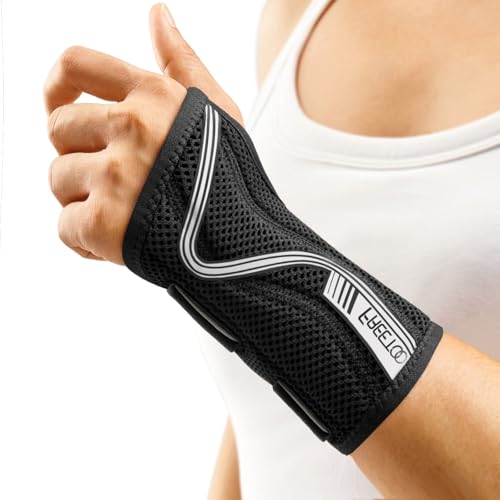
The left-hand version of the FREETOO Night Support mirrors the S-shape construction of its right-hand sibling, with the splint and contour flipped to match the left palm. For left-handed workers, this distinction matters more than it sounds: a right-hand brace on a left hand places the support beam on the wrong side of the wrist and the fit drifts overnight.
Like the right-hand pick above, this model is built for sleep positioning rather than active labor, so it pairs naturally with a daytime compression option. If you type with your left hand on the mouse or work a checkout scanner all day, the FREETOO handles the recovery window; the FUTURO brace covers the shift itself.
Advantages To Know
- Left-hand-specific shaping keeps the splint aligned with the correct palm curve for proper nighttime support.
- Medium size accommodates a wide adult range, lowering the chance of an ill-fitting first attempt.
- Neutral-hand positioning helps reduce the overnight curling that often drives morning stiffness in active workers.
Room For Improvement
- Night-focused bulk makes the brace impractical for daytime scanning, typing, or assembly tasks.
- Hand-specific design means right-hand users must order the mirrored model instead of swapping between the two.
The Right Fit
Left-handed workers whose nighttime symptoms carry into the workday and who want a properly oriented rest brace.
Not Your Match When
Your main symptom is daytime grip strain; the Tiger Paw Gymnastics Wrist Supports offer a lighter, pair-pack option for that scenario.
Heavy tasks demand more than compression. The ZOFORE SPORT brace layers a metal splint stabilizer under two adjustable straps, locking the wrist in a controlled position during repetitive or load-bearing work. For assembly line staff, mechanics, and stockroom crews, the rigid stay does what soft braces can’t: it limits bending motion under stress, which can matter when lifting or pushing is part of the shift.
Available in L/XL for broader wrist profiles and right-hand orientation, the construction skews toward structure over subtlety. Compared to the FUTURO Compression Stabilizing Wrist Brace, this model sacrifices breathability and flexibility for a more locked-in feel.
What Pays Off
- Metal splint stabilizer restricts harmful bending motions during lifting or pushing tasks common in industrial roles.
- Two-strap layout lets you set a base compression and then add targeted pressure where symptoms concentrate.
- L/XL sizing fits broader wrist profiles that smaller-sized braces often miss.
Points To Note
- Rigid construction limits finger mobility, making typing or detailed work harder compared to the FUTURO sleeve.
- Right-hand-specific design means left-handed workers need a different option, like the left-hand FREETOO night brace for recovery.
Feature Snapshot
Whose Shelf It Belongs On
Industrial, warehouse, and mechanic workers who need rigid support through physically demanding shifts rather than light compression.
Reach For A Different Pick When
Your day is keyboard-dominant; the FUTURO Compression Stabilizing Wrist Brace stays out of the way better during typing.
Some working days involve more impact than a keyboard delivers. The Tiger Paw Gymnastics Wrist Supports come as a pair, covering both wrists for activities where landing, tumbling, or pushing weight through the joint is routine. Gymnasts, cheerleaders, and CrossFit-style trainers rely on this style, but the design also fits warehouse handlers and movers who load trucks or stack pallets.
The wrap-style construction is lighter than the rigid ZOFORE SPORT brace reviewed above but more structured than the FUTURO sleeve. For workers who swing between high-impact bursts and lighter tasks, the pair format means one stays on while the other airs out, which extends product life in humid or sweaty conditions.
The Good Stuff
- Pair-pack format covers both wrists at once, useful for bilateral loading tasks like overhead lifts or handstands.
- Wrap-style support stabilizes the joint during impact without the rigid bulk of a full splint brace.
- Athletic design language translates well to non-gym work like moving, climbing, or stunt-related job tasks.
Some Limits To Know
- Wrap construction requires re-wrapping between sessions, and owners commonly report the Velcro wearing out faster than the fabric body.
- Less effective for sustained typing or mouse work compared to the FUTURO compression brace or CarpalAid patch.
Who Should Grab It
Coaches, gymnasts, and workers with bilateral wrist loading who need impact support without committing to a rigid medical-style brace.
A Better Fit Elsewhere
You spend the day typing; the FUTURO Compression Stabilizing Wrist Brace offers better adjustability for office environments.
Choosing Carpal Tunnel Braces That Match Your Workday
Start with the dominant motion of your shift. Typists and register-side retail workers benefit from breathable, open-palm designs that keep fingers mobile while adding compression across the wrist joint, where most of the strain accumulates. Adjustable straps matter here because swelling often varies across a long shift, and a brace that locks in at 9 a.m. may feel wrong by 3 p.m.
For heavier or impact-driven tasks, rigidity becomes the priority. Metal splint stays and wrap-style athletic supports limit harmful bending under load, which protects the joint during lifting or landing. The tradeoff is reduced finger mobility, so these options work poorly for fine-motor tasks like typing.
Finally, think about the time outside your shift. A nighttime positioning brace, with its anatomical curve and bulk, supports the neutral-hand hold that many find useful during sleep. Pairing a daytime compression brace with a nighttime immobilization brace covers both halves of the recovery cycle, though costs rise accordingly.
Sizing deserves a careful pass before ordering. Wrist circumference and hand length both matter, and a brace that fits one hand may not fit the other. Most manufacturers publish measurement guides, and following them closely prevents the common experience of a brace that either cuts off circulation or slides off within minutes.
Where Shoppers Go Wrong and Where The Extra Money Goes
Common Buying Slip Ups
A frequent mistake is choosing a brace by category alone. Night supports, compression sleeves, and rigid splints serve different purposes, and grabbing the wrong type leaves you either over-restrained during the day or under-supported overnight. The second slip is ignoring hand orientation: right- and left-hand-specific braces are not interchangeable, and reversing them misaligns the splint.
What Separates Premium From Basic
Higher-tier braces in this category typically invest in materials that hold up to repeated washing, hinges that allow controlled motion instead of full immobilization, and breathable fabrics that don’t trap sweat. For most working professionals, mid-tier options cover daily needs, but upgrading makes sense when you wear the brace every shift and durability starts to matter more than upfront cost.
Frequently Asked Questions
How long should a carpal tunnel brace be worn during a work shift?
Most working professionals start with a few hours during the highest-strain portion of the day and adjust based on comfort. Brace makers commonly suggest alternating on-and-off periods to avoid over-reliance, though specific wear schedules vary by product design.
Can I type while wearing a rigid wrist brace?
Typing with a rigid metal-stay brace is generally awkward because the stay limits the wrist flexion needed to reach varied keys. Compression braces with open palms handle typing better, while rigid models suit recovery or heavy-lift periods.
Are wrist braces safe to sleep in?
Night-specific braces are designed for sleep positioning and are commonly worn overnight. Day-use compression braces are not built for that purpose and can apply uneven pressure if worn for many hours in a single position.
How do I clean a wrist brace?
Most fabric braces tolerate hand washing with mild soap and air drying. Hook-and-loop closures should be fastened before washing to avoid collecting lint, and metal stays should be removed if the brace design allows it.
What is the difference between left- and right-hand braces?
Hand-specific braces mirror the splint placement to match the natural curve of each palm. Wearing a right-hand brace on the left puts the support on the wrong side of the joint, which can shift the fit and reduce effectiveness overnight.
Closing Thoughts
The right brace matches the task you actually do: typing, lifting, or recovering overnight. Pick from this shortlist based on the dominant demand of your shift, and don’t hesitate to combine a daytime compression option with a nighttime positioning model if symptoms span both windows.