

A rolled ankle on a trail run, a tweak during pickup basketball, the slow ache of plantar fasciitis on a long shift. Ankle Support Braces fill different roles for different bodies. The right one stabilizes a joint under heavy lateral stress, while a softer sleeve helps you stay mobile through daily life. This list sorts eight real options by use case so you can match the design to your situation without overthinking it.
The Picks In Brief

Bunga Ankle Sleeve (5″)
McDavid Lace-Up Ankle Brace Figure 8
DonJoy Stabilizing Speed Pro Ankle Brace

ACE Deluxe Adjustable Ankle Brace (2-Pack)

Back on Track Physio 4-Way Stretch Ankle Brace

Med Spec ASO Ankle Stabilizer Lace-Up (Black, LG)

INDEEMAX Copper-Infused Compression Ankle Brace

Fitomo Quick Lace Up Ankle Brace with Splints
A Closer Look At Each Pick
Most braces on this list chase stability through structure, but the Bunga Ankle Sleeve (5″) solves a quieter problem. Stiff hockey boots, figure skates, roller blades, and inline skates rub the ankle bones raw over a long session, and that friction can ruin a session faster than any rolled joint. This short sleeve slips over the ankle with a gel layer that absorbs the rubbing pressure before it reaches the skin.
It comes in a 5-inch length and is sold individually, so it suits skaters who only need targeted padding over one ankle or those who already own a brace and want a comfort layer underneath. Compared with the McDavid Lace-Up Ankle Brace reviewed next, this sleeve offers almost no structural support, but that is the point. It is a comfort sleeve first and a stabilizer a distant second.
Noteworthy Benefits
- Gel cushioning softens the hot spots that stiff skate boots create over the ankle bones
- Slips on without laces, hooks, or adjustment, so kids can manage it on their own
- Compact 5-inch profile stays hidden inside most athletic footwear without bunching
- Worn alone or layered under a heavier brace for hybrid comfort and support
Points To Note
- Provides no real lateral stability for a freshly sprained ankle or a weak joint
- Gel pads can shift during aggressive skating, so periodic readjustment is part of ownership
- Sold as a single sleeve, so covering both ankles costs twice as much
Who It Suits Best
Hockey players, figure skaters, and roller or inline skaters who battle friction inside stiff boots more than instability in the joint itself.
Consider Something Else When
Skippers who also need real stabilization should look at the McDavid Lace-Up Ankle Brace for proper figure-8 support.
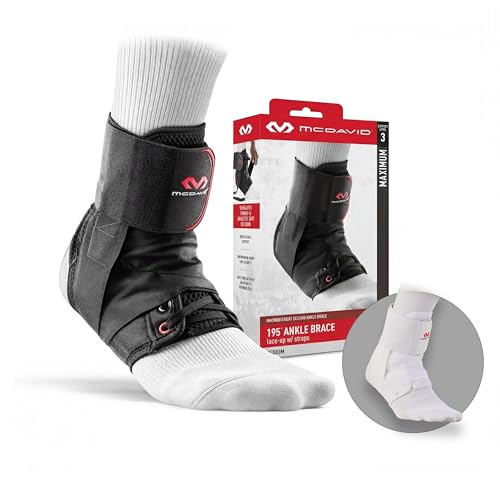
The McDavid Lace-Up Ankle Brace Figure 8 is a classic athletic design that has stuck around for a reason. A figure-8 strap wraps the heel and forefoot in a pattern that limits rolling while the lace-up closure lets you dial in compression. The build uses rigid side stabilizers, plastic stays along the sides of the ankle, that resist sideways motion without locking the joint into place.
It works across basketball, volleyball, soccer, football, and trail running, which is why it lives in so many gym bags. You can adjust the laces once and slip the brace on with the laces pre-set, saving setup time at the gym. Compared with the Bunga sleeve above, this one trades comfort for genuine joint protection, and most athletes would call that a fair trade.
Strengths Worth Knowing
- Figure-8 strap pattern is a well-known design for limiting ankle roll during cutting sports
- Side stabilizers add structure without making the brace feel like a cast
- Lace closure lets you tune compression across the top of the foot and around the ankle
- Versatile across basketball, volleyball, soccer, football, and running for shared use
Trade Offs
- Lace-up setup takes longer than slipping on a sleeve before a quick practice
- Bulky enough that low-cut or narrow shoes may feel tight over the brace
- Material can wear through the eyelets after a season of heavy use
Feature Snapshot
Right Fit For
Multi-sport athletes who want one adjustable brace that handles basketball courts, soccer fields, and trail runs in the same week.
Look Elsewhere When
People who only need a thin compression layer should consider the INDEEMAX sleeve for a lower-profile feel under everyday shoes.
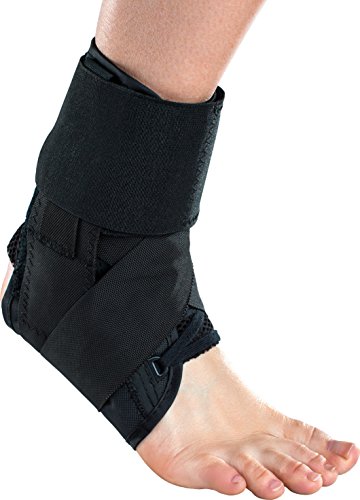
The DonJoy Stabilizing Speed Pro Ankle Brace is built like athletic equipment that expects to get punished. The shell uses 800-denier ballistic nylon (a thick, abrasion-resistant fabric originally developed for military gear), and the reinforced eyelet area keeps the lace anchors from tearing out under repeated tightening. That matters in season-long wear, not just a single practice.
The speed element shows up in how the lace locks down with a hook-and-loop closure on top, so once the laces are set you do not re-tie them every time. A figure-8 strap pattern finishes the lock-down. Where the McDavid brace above aims for balance, the Speed Pro leans hard into a stiffer, more locked-in feel, which is the point.
The Helpful Details
- 800D ballistic nylon body resists scuffs from turf, mats, and court surfaces
- Reinforced eyelet area keeps the lace anchor from ripping out over a season
- Speed closure trims setup time once the laces are set to your fit
- Figure-8 strapping locks the calcaneus (heel bone) in place during cutting moves
Things To Consider
- Heavier and stiffer than lighter braces, so agility drills feel different at first
- Thick shell can be a tight squeeze inside low-profile cleats
- Priced above entry-level braces because of the tougher fabric
Made For
Hard-training athletes, trainers, and physical therapists who want a brace that survives a long season of practices and games.
Not Your Match When
Casual gym-goers or people with mild daily soreness should consider the ACE Deluxe Adjustable Ankle Brace for lighter everyday wear.
The ACE Deluxe Adjustable Ankle Brace sells in a two-pack, which makes it easy to cover both ankles or keep a spare in the car. The design is a moderate-stabilizing slip-on: reinforced side stabilizers that resist lateral motion, plus a simple wrap that pulls on without laces. It is built for daily wear rather than high-level competition.
For people easing back into exercise after a minor sprain, or anyone who wants a basic stabilizer for long shifts on their feet, this is the kind of low-fuss option that works in sneakers, work boots, and casual shoes. Compared with the DonJoy Speed Pro above, the ACE brace trades structural toughness for easier everyday use and a friendlier fit in regular footwear.
Useful Highlights
- Two-pack covers both ankles or rotates between workouts and recovery days
- Slip-on design saves time over a full lace-up system
- Reinforced side stabilizers limit sideways motion without locking the joint
- Fits inside a wide range of footwear from sneakers to casual boots
Honest Caveats
- Provides moderate stabilization rather than the locked-in feel sport braces offer
- Adjustable wrap can loosen during long walks and needs occasional re-tightening
- Not designed for high-impact cutting sports like basketball at full pace
Feature Rundown
Best Suited To
Workers on their feet, casual walkers, and anyone managing a minor sprain who wants a simple, no-fuss stabilizer for daily life.
A Better Fit Elsewhere
Competitive athletes will get more from the Med Spec ASO Ankle Stabilizer, which is tuned for higher-demand training.
The Back on Track Physio 4-Way Stretch Foot and Ankle Brace takes a different angle than every other pick on this list. Instead of relying on rigid stays or thick compression fabric, it uses Welltex technology, a textile embedded with minerals that reflect body heat back toward the skin. The idea is gentle warmth that supports circulation during recovery phases.
It is a 4-way stretch design, meaning the fabric moves with the ankle in any direction rather than fighting certain motions. That makes it a comfortable option for evenings on the couch, slow walks, or sleep after a long day on a sore joint. Compared with the ACE brace above, this one feels less like a stabilizer and more like a recovery tool you wear between activities.
Where It Delivers
- Welltex fabric reflects body heat back toward the skin for a warming sensation
- Four-way stretch moves with the ankle rather than restricting natural motion
- Slip-on profile fits comfortably inside slippers or loose-fitting shoes
- Useful during the later stages of recovery when stiff braces feel too aggressive
Points To Keep In Mind
- Provides gentle warmth rather than true mechanical stabilization for active sports
- Heat-reflective effect is subtle and may not register in cool environments
- Less structured support than lace-up or wrap braces during cutting movements
Whose Shelf It Belongs On
People in the later stages of ankle recovery, or anyone with chronic stiffness who wants a warming sleeve to wear between workouts.
Swap It Out When
Runners returning to hill work should reach for the INDEEMAX sleeve for firmer compression during actual training miles.
The Med Spec ASO Ankle Stabilizer Lace-Up is the brace most athletic trainers reach for first when a player rolls an ankle mid-game. Its design has been refined over many seasons: a lace-up body, figure-8 strap, and elastic cuff that wraps the top of the ankle. Together they create a stable lock without turning the joint into a cast.
This Large size suits bigger ankles, and the same model comes in other sizes for slimmer fits. It handles sprain recovery, ligament and tendon support, and chronic ankle instability with the same structure. Compared with the McDavid 101 Figure 8 above, the ASO adds a more developed cuff design and a reputation built inside training rooms, which matters to anyone returning from a serious tweak.
The Case For It
- Figure-8 strap and lace combo is widely recommended by trainers and physicians
- Elastic cuff finishes the lock around the top of the ankle for a tidy fit
- Handles both recovery from acute sprains and ongoing instability
- Available in multiple sizes for a more tailored fit than one-size designs
Worth Bearing In Mind
- Larger footprint than a basic sleeve, so it crowds narrow shoes
- Takes practice to lace up correctly the first few times
- Stitching on the figure-8 strap can wear under very heavy use
Built With In Mind
Recovering athletes, gym regulars with chronic instability, and anyone whose trainer has specifically recommended a figure-8 lace-up design.
Where A Sibling Pick Shines
Skaters and boot wearers looking for friction cushioning will find a better match in the Bunga Ankle Sleeve reviewed earlier.
The INDEEMAX Copper-Infused Compression Ankle Brace is a stretchy knit sleeve designed to slip on like a sock. The fabric is a copper-infused nylon blend with a touch of spandex for stretch, which gives the sleeve a smooth, low-profile feel under everyday shoes. It targets sore ankles from sprains, plantar fasciitis discomfort, and Achilles tendon soreness.
You get gentle compression rather than the locked-in feel of the ASO or DonJoy braces reviewed above. That makes it a reasonable pick for desk days, walks, or light training, the moments when you want the joint to feel held without bulk. Compared with the Back on Track brace, this one runs cooler and is easier to wash between wears.
Useful Strengths
- Stretchy knit slips on like a sock, with no laces to fuss with in the morning
- Copper-infused nylon helps manage odor during long wear
- Low-profile design fits inside sneakers, casual shoes, and even some dress shoes
- Compresses the joint enough for daily support without rigid stays
Practical Considerations
- No rigid stays, so it does not protect against hard lateral rolls
- Compression strength drops as the knit relaxes after several wears
- Knit fabric can snag on Velcro from other braces or shoes
Feature Snapshot
Perfect Match For
Office workers, casual walkers, and anyone managing plantar fasciitis or Achilles soreness who wants light compression during the day.
Another Choice May Suit
Anyone returning to cutting sports should pick the Med Spec ASO Ankle Stabilizer for real structural support during drills.
The Fitomo Quick Lace Up Ankle Brace with Splints blends two ideas into one package. The body is a lace-up design that locks the heel in place, while the side stabilizers are removable plastic splints. You can pull them out for lighter wear or keep them in for more aggressive training days, which makes the brace adapt as your ankle heals or strengthens.
Sizing runs from Small through XL, with the chart built around a heel-to-instep tape measure. In practice, the quick-lace design trims setup time over a traditional lace-up once you have found your fit. Compared with the DonJoy Speed Pro above, this one trades ballistic-nylon toughness for the option to soften the brace as recovery progresses.
Advantages To Know
- Removable side splints let you adjust the brace as recovery progresses
- Quick-lace design trims setup time once the fit is dialed in
- Multiple sizes cover a wider ankle range than one-size designs
- Works for both training days and lower-demand daily wear
Where It Is Less Suited
- Bulky in shoes compared with a slim compression sleeve like INDEEMAX
- Side splints can press against the ankle bone on sharp cuts if not seated right
- Lace eyelets may need periodic checks after months of daily use
Feature Breakdown
Who Should Grab It
Recovering athletes and active adults who want one brace that adapts from early rehab through full training over the course of a season.
Reach For A Different Pick When
People who only want a thin warming sleeve for sleep or rest days should consider the Back on Track Physio for that purpose.
What Matters Most Before Choosing Ankle Support Braces
Match The Brace To The Problem
A sprained ankle that is fresh needs a lace-up brace with figure-8 straps, like the Med Spec ASO or McDavid Figure 8, because mechanical restriction supports healing. A chronic weak ankle benefits from a sleeve-style brace with side stabilizers, like the ACE Deluxe or Fitomo, that you can wear all day under shoes. A sore joint from plantar fasciitis or tendonitis usually only needs gentle compression and warmth, which is where copper-infused sleeves or the Back on Track Physio fit best. The honest read is that buying the wrong category for the wrong problem is the most common mistake, even if the brace itself is well made.
Decide Between Compression And Stabilization
Compression sleeves hug the joint with stretchy fabric to manage swelling and improve proprioception (your sense of where the joint is in space). Stabilizer braces add rigid stays, laces, or figure-8 straps to physically limit motion. Compression is enough for mild soreness and daily comfort. Stabilization is the right call after an acute sprain or when the joint rolls during sports. Mixing them up wastes money and slows recovery.
Think About Shoe Fit And Setup Time
Lace-up braces with side stabilizers crowd low-cut and narrow shoes. Sleeves fit anywhere but offer less protection. Quick-lace designs cut setup time after the first fitting, while full lace-ups give finer tuning. Anyone who needs to slip the brace on and off quickly should favor the quick-lace or slip-on category.
Plan For Sizing And Replacement
Most braces need accurate sizing to work properly. Wrap the ankle from heel to instep with a tape measure before buying, especially for lace-ups like the Fitomo. Brace fabrics stretch and stitching wears, so a brace used daily may need replacement each season. Planning for that lifespan keeps your support from quietly degrading mid-year.
Key Considerations Across These Picks
Where Shoppers Go Wrong
The most common mistake is treating all ankle support braces as interchangeable. A skate-comfort sleeve and a clinical stabilizer solve very different problems, and choosing between them by price alone usually backfires. Another pitfall is ignoring sizing. A brace that is too loose shifts during play and gives a false sense of security, while one that is too tight can cut off circulation. Measure your ankle first, then match the chart to your selection. Finally, do not skip the readjustment period. Even well-fitted braces need minor tightening after the first ten minutes of wear.
When Paying More Pays Off
Higher-tier braces in this category, like the DonJoy Speed Pro or Med Spec ASO, cost more because of tougher fabrics, reinforced eyelets, and refined strap patterns that survive a long season. The extra spend makes sense for athletes training several times a week, people returning from a serious sprain, and trainers outfitting multiple players. For casual users, a mid-range brace or a quality compression sleeve handles the same daily tasks without the heavier construction. You pay more for durability and refined lock-down, not for a fundamentally different kind of support.
Frequently Asked Questions
How tight should an ankle support brace feel?
A properly fitted ankle support brace should feel snug and supportive without cutting off circulation, with enough room to slide one finger under the top edge. You may need to re-tighten laces or straps after ten minutes of wear as the fabric settles.
Can I wear an ankle support brace all day?
Most ankle support braces can be worn through a full active day, though recovery sleeves with warming fabric are usually better for rest periods. Lace-up stabilizers with rigid stays are best reserved for training sessions rather than sleeping.
Are lace-up braces better than compression sleeves?
Lace-up braces with side stabilizers offer stronger mechanical support, while compression sleeves offer lighter, all-day comfort. The better choice depends on whether you need to limit motion or simply manage mild soreness.
Should I size up if I am between sizes?
Sizing up slightly is safer than sizing down for lace-up braces, since a tight fit can restrict blood flow during swelling. For compression sleeves, staying closer to your measured size keeps the compression effective.
How long does an ankle brace typically last?
With regular use, most ankle support braces last around six to twelve months before elastic loosens or stitching wears. Lace-up braces with reinforced eyelets tend to outlast basic sleeves under heavy training.