

Sprained ankles and ligament injuries don’t wait for convenient timing. Whether you rolled a lateral ligament on a weekend trail run or aggravated an old injury during pickup basketball, the right support changes how comfortably you move through daily life. This roundup cuts through the noise to eight braces and sleeves that handle swelling, instability, and gradual return-to-activity demands. Each option was chosen for clear, different reasons: some lock the joint down hard, others deliver graduated compression, and a few strike a quiet balance. Use it as a starting point, then match the design to your injury stage and sport.
A Closer Look At The Lineup

Procare Ankle Support Stabilizer Medium 79-81355
DonJoy Stabilizing Speed Pro Ankle Brace
Z Athletics Reinforced Lace Up Ankle Brace

Modvel Foot & Ankle Brace Socks Compression Sleeve
Modvel Slim Lace Up Ankle Brace Figure 8

Modvel Ankle Brace Socks with Adjustable Strap
KEKING Ankle Compression Sleeve for Plantar Fasciitis

Z Athletics Ankle Brace with Side Stabilizers
What Each Pick Brings To The Table
The Procare Ankle Support Stabilizer sits at the more clinical end of this lineup, built for people whose ligament injury still feels unstable weeks in. The semi-rigid shell on either side of the joint limits the rolling motion that re-tears a healing lateral ligament, while a fabric-covered body keeps the brace tolerable against bare skin during long days at a desk or on light duty.
For someone stepping down from a walking boot but not ready for a soft sleeve, this strikes a useful middle ground. It runs warm under a sneaker, so plan around it for short outings rather than full shifts. Compared to the soft Modvel sleeves coming up later, Procare is the firmer handshake.
The Upside
- Semi-rigid side shells physically block the inversion (outward roll) that aggravates lateral ligament tears.
- Adjustable straps let you loosen it for swelling mornings and tighten it again for evening walks.
- Works as a transitional brace between a walking boot and a soft sleeve during rehab.
- Compatible with most wide athletic shoes, a meaningful upgrade over bulkier walker-style braces.
- Provides clear proprioceptive feedback (your brain’s sense of joint position), which helps prevent re-injury on uneven ground.
Trade Offs To Consider
- Too firm for sleep or casual lounging; the rigid panels press into the opposite leg.
- Runs warmer than the knit sleeves, so hot-weather comfort takes a hit.
- Sizing runs on the small side; most shoppers report sizing up if between ranges.
Right Fit For
Shoppers recovering from a moderate to severe sprain who need real mechanical support, not just compression, during daily activity.
Reach For A Different Pick When
The DonJoy Stabilizing Speed Pro serves athletes who want faster lace-up changes during games and practice sessions.
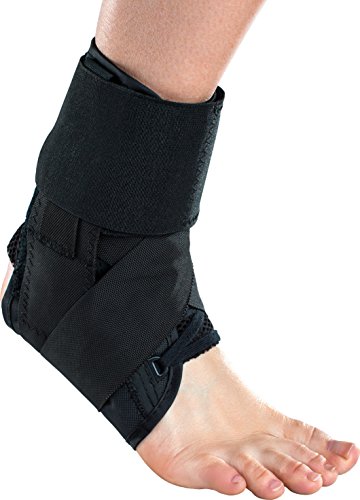
DonJoy’s Stabilizing Speed Pro lands here because it borrows athletic trainers’ playbook rather than the medical-shelf formula. The 800D ballistic nylon (an abrasion-resistant fabric originally developed for military gear) shrugs off turf drag and repeated lace tension, while reinforced eyelets keep the figure-8 strapping from pulling through after months of hard cuts. The “speed” in the name refers to the closure: laces, then a single Velcro wrap, then you’re out the door.
Most shoppers using it on a recovering ankle will notice the trade-off between security and bulk. Compared to the Procare stabilizer above, DonJoy feels less like a cast and more like a sports tool, which is exactly the point. For a high-school or college athlete returning from a grade II sprain, the speed of application matters during tournament weekends.
Real Benefits
- 800D ballistic nylon resists abrasion far longer than standard knit braces on courts and turf.
- Figure-8 strapping pattern mimics professional taping, supporting the anterior talofibular ligament (the most commonly sprained ankle ligament).
- Quick-pull closure trims application time during multi-game days.
- Trusted brand pedigree widely used in college and professional training rooms.
Honest Caveats
- Heavier than sleeve-style braces, which some users find tiring over a full day.
- Lace replacement requires care; owners commonly report fraying after a season of hard use.
- Priced higher than most picks on this list, reflecting the brand and materials.
Built With In Mind
Returning competitive athletes in basketball, football, or soccer who need pro-level support and don’t mind the learning curve of a real taping-style brace.
Consider Something Else When
The Z Athletics Reinforced Lace Up Ankle Brace offers a similar figure-8 concept at a friendlier price for recreational court players.
The Z Athletics Reinforced Lace Up Ankle Brace targets a familiar complaint: bulky braces that won’t fit inside a basketball shoe. The figure-8 lacing system is slim enough to disappear under most sneakers, and the reinforced eyelets give the laces something to bite into during hard lateral cuts. Shoppers running pickup games after work will appreciate the trade-off this brace makes.
Unlike the DonJoy Speed Pro above, this model uses a more straightforward lace-and-Velcro pattern without the heavier ballistic shell. That keeps weight and cost down. Most users find it useful for both game play and post-game recovery wear, depending on how tightly they lace it.
The Value In It
- Low profile fits inside most basketball and cross-training shoes without a size-up.
- Figure-8 strapping follows athletic-taping logic, helping stabilize the lateral ligament complex.
- Hand-washable fabric shell holds up to repeated sweat cycles during multi-day tournaments.
- Suitable for both men and women without separate SKUs, simplifying reorders.
Worth Noting
- Lacks rigid side stays, so it supports rather than fully blocks severe inversion risk.
- Velcro pile catches on sock material over time; owners commonly trim stray fuzz to keep the wrap tight.
Best Suited To
Recreational basketball and volleyball players working back from a mild-to-moderate sprain who want game-day support that doesn’t require a half-size larger shoe.
Look Elsewhere When
The Z Athletics Ankle Brace with Side Stabilizers adds rigid stays for users whose ankles still feel loose on the lateral side.
The Modvel Foot & Ankle Brace Socks pull a different trick: they slip on like a sock and stay in place through your commute. Calibrated compression, meaning the knit is tighter at the foot and looser up the leg to push fluid upward, encourages circulation, while the open-heel design keeps the brace breathable under a dress shoe or loafer. For someone whose ligament injury has moved past the acute swelling phase, that profile is genuinely useful.
Compared to the rigid Procare stabilizer at the top of this list, Modvel’s sleeve is the opposite philosophy: no shells, no straps, just graduated knit. Shoppers managing chronic ankle instability from old ligament damage often rotate it in for daily wear, saving firmer braces for workouts. The honest read is that it supports confidence more than it locks down a wobbling joint.
A Few Strong Suits
- Slip-on sock format disappears under business and casual shoes alike.
- Calibrated compression helps reduce the end-of-day swelling that follows mild sprains.
- Knit fabric breathes far better than neoprene during summer errands.
Some Limits To Know
- Limited mechanical stability for sharp lateral movements on the basketball court.
- Knit can pill (form small fabric balls) at the heel after several wash cycles; owners commonly hand-wash and air-dry to extend life.
Quick Facts
Who Should Grab It
Office workers and casual walkers managing mild ligament soreness who want a brace they forget they’re wearing by lunchtime.
Swap It Out When
The KEKING Ankle Compression Sleeve delivers a similar sock-style fit with a more pronounced 20-30mmHg compression level for heavier swelling.
Modvel’s Slim Lace Up Ankle Brace threads the needle between the rigid Procare stabilizer and the slip-on sleeve above. The figure-8 strap geometry is the same pattern trainers use when they tape an ankle pre-game, but the body is a thin nylon shell with soft padding over the Achilles. That padding matters during long runs; without it, the strap edge digs into the back of the heel.
For someone training through a mild ligament sprain, this gives real mechanical support without forcing a shoe-size jump. The trade-off is that it laces up slower than the slip-on Modvel sleeve. Shoppers who value a low silhouette in their trainers will find the extra ten seconds worthwhile.
Noteworthy Benefits
- Soft pads over the Achilles prevent strap-edge irritation during longer runs.
- Figure-8 strapping produces measurable lateral stability without bulky plastic stays.
- Adjustable lace tension lets you tighten for a sprint and loosen for recovery walking in the same day.
Points To Note
- Less rigid than the Z Athletics brace with side stabilizers, so severe instability may still feel under-supported.
- Lace ends can fray; a small knot or wrap keeps them tidy after a few weeks of use.
Whose Shelf It Belongs On
Runners and gym-goers rebuilding ankle strength who want a lace-up brace that fits inside standard running shoes without forcing a size change.
Skip It When
The DonJoy Stabilizing Speed Pro is the smarter choice for athletes who need tougher fabric and a faster closure on game days.
This Modvel entry adds an adjustable strap to the sleeve formula, giving you a hybrid that compresses and supports at once. The strap compression tech wraps over the joint for targeted pressure exactly where ligament tenderness peaks, while the sleeve underneath keeps the fabric from bunching. For people whose swelling varies day to day, that adjustability is the real value.
Versus the bare sleeve earlier in this list, the strap adds bulk you need to plan around with footwear. Most users find a roomy sneaker accommodates it fine, while slimmer shoes feel tight. Compared to the Procare stabilizer, this is a much softer, more forgiving support, useful in the later phases of recovery.
Everyday Advantages
- Removable strap lets you step down to sleeve-only wear as recovery progresses.
- Targeted compression over the malleolus (the bony bumps on either side of the ankle) reduces swelling where it pools most.
- Knit sleeve breathes well enough for desk workers wearing it under trousers.
Small Caveats
- Adds noticeable bulk; slim dress shoes won’t close over it.
- Strap velcro loses grip after several months; replacement straps tend to outlast the brace body.
Key Product Details
Who Will Love This
Shoppers in mid-recovery who want to dial compression up during flare-ups and back down on calm days without buying two braces.
A Better Fit Elsewhere
The KEKING Compression Sleeve is the right pick for users who want a fixed graduated compression level without the strap complexity.
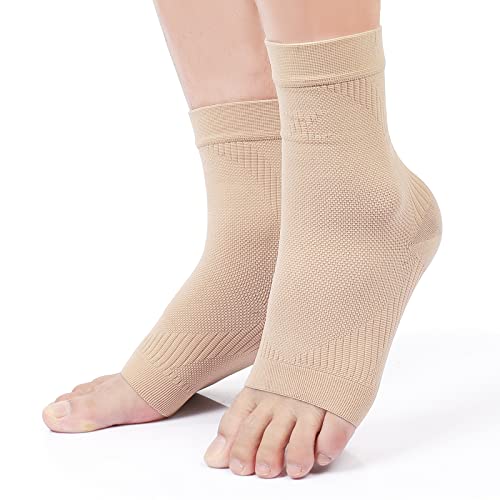
KEKING’s compression sleeve earns its place through a clear, specific commitment: 20-30mmHg graduated compression, the medical-grade range that supports circulation without choking the limb. The knit stabilizes the arch and heel at the same time it cups the ankle, which is useful when a ligament injury coexists with plantar fascia pain. Shoppers on their feet all day tend to feel the difference at hour eight.
Unlike the strap-equipped Modvel sleeve, KEKING keeps things simple: pull it on, forget about it. For runners and nurses managing recurring ankle swelling, that simplicity is a feature, not a limitation. Compared to the Procare rigid stabilizer, it’s a fundamentally different tool: less mechanical, more circulatory.
Strong Points
- 20-30mmHg graduated compression falls in a clinically meaningful range for circulation support.
- Knit construction stabilizes both the arch and the ankle joint, addressing two complaint areas at once.
- Slip-on profile works under socks and standard shoes without a sizing adjustment.
- Useful across plantar fasciitis, Achilles stiffness, and mild ligament sprains.
A Few Limitations
- Compression class can feel intense for first-time sleeve users; many ease into 30-minute sessions.
- Provides no rigid protection against a sharp lateral roll on uneven terrain.
Feature Snapshot
Made For
Healthcare workers, retail employees, and runners logging long shifts on hard floors whose ankle ligament recovery overlaps with arch and heel complaints.
Where Another Pick Suits Better
The Modvel Foot & Ankle Brace Socks serve shoppers who want similar compression with a softer 15-20mmHg feel for casual daily wear.
Z Athletics closes the list with a brace that adds rigid side stabilizers to the lace-up format, splitting the difference between the soft sleeve family and the full Procare shell. The plastic stays on either side physically prevent inversion, while the lace body keeps the fit customizable through a long match. Volleyball and basketball players rotating through spikes and quick cuts tend to value this combination most.
Compared to the original Z Athletics Lace Up Brace earlier in the list, this version trades a slimmer profile for real mechanical protection. Shoppers whose ankles still feel loose weeks into rehab will notice the difference. The honest read is that it’s heavier than a sleeve, but for that extra weight you get actual structural support.
Where It Excels
- Side stabilizers deliver mechanical inversion control during jumping and landing.
- Lace body allows fine-tuned compression across the metatarsals (the long bones of the midfoot) and ankle.
- Suitable for basketball, volleyball, and running without swapping shoes.
- Open-heel design prevents heat buildup during multi-set matches.
- Reasonable value compared to premium brands offering similar stabilizer layouts.
Practical Considerations
- Heavier than pure sleeve braces; expect a short break-in period.
- Plastic stays can press into the opposite ankle if you sleep in it, so daytime-only wear is the safe call.
- Lace maintenance matters; loose laces reduce the brace’s protective effect.
Technical Reference
Perfect Match For
Court-sport athletes in mid-to-late rehab who need real side protection but don’t want a full medical brace under their game sneakers.
Not Your Match When
The Procare Stabilizer is the right answer for shoppers whose ligament injury still demands a more clinical, semi-rigid shell during daily life.
Matching The Brace To Your Stage Of Recovery
The right ankle support depends on where your ligament injury actually sits on the recovery timeline. Acute injuries, meaning the first one to three weeks when swelling and pain dominate, usually benefit from compression sleeves and rigid braces that limit motion and reduce swelling. Subacute injuries, roughly weeks three through eight, often do better with lace-up figure-8 braces that allow controlled loading while the ligament regains tensile strength. Chronic instability, meaning recurring ankle “giving way” months after the original injury, calls for daily sleeves plus targeted strengthening rather than constant bracing.
Material matters more than marketing suggests. Neoprene retains heat, which soothes stiff joints but irritates hot, swollen tissue. Knit compression sleeves breathe better and wick sweat, making them the better daily-wear choice. Nylon and ballistic fabric braces trade breathability for durability on the court or trail. Shoppers managing skin sensitivity should favor seamless knit construction over stitched seams, which can rub raw during long wear.
Sizing is where most first-time buyers go wrong. A brace that’s too small restricts circulation and causes numbness behind the toes. One that’s too loose migrates during walking and stops protecting the joint. Measure your ankle circumference at the narrowest point above the malleolus, then check the brand’s sizing chart rather than guessing on shoe size. Re-measure if significant swelling has resolved, since a brace fitted during peak swelling often becomes too large weeks later.
Things To Weigh Before You Click Buy
Where Shoppers Go Wrong
The most common mistake is choosing the brace category based on the original injury rather than the current stage. A heavy Procare stabilizer feels right on day three of a bad sprain but becomes a burden by week six, when the joint needs graded loading, not full immobilization. Shoppers who pick the brace they wish they had rather than the brace they need now often end up with two purchases instead of one.
Sizing is the second trap. Skipping the measuring tape and guessing based on shoe size leads to braces that migrate, bunch, or cut off circulation. Re-measure after the worst swelling subsides, and trust the chart over the label.
Where The Extra Money Goes
Premium pricing in this category mostly buys material upgrades and brand pedigree. The DonJoy Speed Pro’s 800D ballistic nylon genuinely outlasts economy nylon on abrasive surfaces, and the reinforced eyelets prevent the most common failure point on lace-up braces. For athletes training five days a week, that durability math works out. Casual users wearing a brace twice a month may not recoup the difference.
Compression class is the other place higher prices show up. Sleeves rated at 20-30mmHg deliver medical-grade pressure, while budget sleeves often land closer to 15mmHg. For real swelling management, that compression-class gap matters more than fabric brand names.
Frequently Asked Questions
How long should I wear an ankle brace each day?
During the acute phase, wear the brace whenever you’re bearing weight, typically 4-8 hours. As recovery progresses, taper down to activity-only wear, which lets the joint rebuild natural strength without constant external support.
Can I sleep in an ankle brace?
Soft compression sleeves are generally safe for sleep, since they apply gentle pressure without rigid parts. Semi-rigid braces with side stabilizers should come off at night, as the plastic stays press into the opposite ankle and disturb circulation.
What’s the difference between a sleeve and a lace-up brace?
A sleeve delivers graduated compression to reduce swelling and provide proprioceptive feedback. A lace-up brace offers mechanical support through figure-8 strapping, which physically limits the joint’s range of motion during activity.
How do I clean an ankle brace?
Most fabric braces and sleeves can be hand-washed in mild soap and air-dried. Skip the dryer for knit sleeves, since heat breaks down the elastic fibers and shortens the brace’s useful life.
When should I see a clinician instead of bracing at home?
Severe swelling, inability to bear weight, visible deformity, or numbness in the toes warrants professional evaluation before self-bracing. A clinician can rule out fractures and grade the ligament damage accurately.
The Takeaway
Ankle braces work best when they match your stage of injury, your activity, and your shoe. Start by clarifying which of those three variables matters most, then narrow this list to the two or three braces that address it. The right fit will fade into the background of your day, which is the highest compliment a brace can earn.