A rolled ankle on the pitch feels different from a garden-variety twist. Cuts, pivots, and studs on wet grass put real lateral force on the joint, and once the ligaments have been stretched, every return to training carries a little doubt. The right brace absorbs that sideways stress, keeps the swelling in check, and lets you rebuild proprioception, your brain’s awareness of joint position, without guarding every step.
Eight options line up below, from cold-therapy wraps for the first seventy-two hours to rigid lace-ups for heavy Grade III injuries. You’ll see compression sleeves for daily wear, figure-8 systems for basketball-style cuts, and stabilizers built for chronic instability. Pick by sprain severity, sport demands, and how much bulk you tolerate inside a boot.
A Fast Comparison Of The Options

Shock Doctor Ice Recovery Compression Ankle Wrap
Z ATHLETICS Reinforced Lace Up Ankle Brace

Sleeve Stars Ankle Brace Men & Women Support

Sleeve Stars Ankle Brace with Adjustable Strap

Sleeve Stars Ankle Support for Ligament Damage
KEKING Ankle Brace Compression Sleeve

ZAMST A2-DX Ankle Brace for Heavy Sprains

Z ATHLETICS Ankle Brace with Side Stabilizers
What Each Pick Brings To The Table
Right after a lateral roll on the pitch, the priority is swelling control. The Shock Doctor Ice Recovery Compression Ankle Wrap pairs a reusable gel pack with a wrap-style sleeve that pulls the cold deep into the soft tissue, and it comes sized for larger ankles in the Large/X-Large build. Box dimensions run roughly 26 cm by 13 cm by 11 cm, so it tucks into a kit bag without drama. Unlike the Sleeve Stars options later in this list, this one isn’t built for running, it’s a recovery-room tool.
You slide the gel sleeve on, chill it in the freezer between sets, and the compression shell keeps firm contact without a freezer-burn sting. For the first three to five days after a Grade I or II sprain, when micro-tears still bleed into the joint capsule, that combination tends to settle throbbing faster than a passive ice bag ever does.
Positive Points
- Two-in-one design combines cold therapy and compression in one wrap
- Reusable gel pack stays flexible after freezing for better skin contact
- Adjustable shell fits swelling that changes hour by hour
- Large/X-Large sizing accommodates athletic calf and ankle dimensions
- Slips into a kit bag or recovery cooler between training sessions
Things To Consider
- Not designed to wear during drills, so it can’t stabilize on the pitch
- Gel requires freezer access, which complicates away-game recovery
- Velcro pile can collect lint and shed over a season of heavy use
Who It Suits Best
Players in the first seventy-two hours after a fresh sprain who need to control swelling before they can even think about return-to-play bracing.
Where Another Pick Suits Better
Once you’re cleared to load the joint again, the ZAMST A2-DX Ankle Brace for Heavy Sprains offers real on-field rigidity that this wrap simply can’t.
Returning to a Sunday league fixture after a Grade II inversion calls for something more locked-down than a compression sleeve but less bulky than a rigid stirrup. The Z ATHLETICS Reinforced Lace Up Ankle Brace answers that middle ground with a figure-8 lacing pattern, a wrap of criss-crossing straps that mimics professional taping, that lets you dial compression over the lateral ligaments without removing the boot. Compare that to the Shock Doctor wrap above, which is for the couch, not the pitch.
The construction uses reinforced eyelets along the medial and lateral seams, so the laces hold tension even after a full match of cuts. Athletes moving between basketball, volleyball, and soccer often keep this style in rotation because it slips under a cleat without forcing you to size up.
A Few Strong Suits
- Figure-8 lacing mimics athletic tape for personalized compression
- Low-profile enough to fit inside most soccer boots without resizing
- Open-heel design keeps ventilation decent in summer matches
- Unisex sizing covers a wide range of ankle widths
Worth Noting
- Lacing takes practice the first few times, faster than tape but slower than a sleeve
- Fabric laces stretch and need re-tightening mid-game in heavy use
- Less rigid than plastic-stabilized braces, so Grade III cases may feel under-supported
Key Specs
Made For
Recreational soccer players returning from a mild-to-moderate sprain who want taping-style support they can apply themselves at the field.
Look Elsewhere When
Your clinician has flagged chronic instability or a Grade III tear, the ZAMST A2-DX Ankle Brace for Heavy Sprains brings rigid plastic stays that this lace-up simply cannot match.
On normal training days, when the sprain is weeks old and the swelling has calmed, you mostly want gentle compression and proprioceptive feedback, the small sensory cues that remind your brain the ankle is there. The Sleeve Stars Ankle Brace Men & Women Support is a single sleeve in the Medium size range (10″ to 12″ ankle circumference), knit from a breathable fabric that grips without strangling. It slides on like a sock and disappears under a sock after that.
The point of this pick is volume. You can wear it through a full practice, throw it in the wash, and pull it back on for tomorrow’s session. Where the Shock Doctor wrap is a tool, this is closer to apparel.
What Helps Most
- Pull-on sleeve design takes seconds to fit before warm-ups
- Knit fabric wicks sweat during long training sessions
- Low bulk layers under a sock without crowding the boot
- Medium sizing covers most adult ankle circumferences
Honest Caveats
- No rigid component, so it won’t stop a hard lateral roll on its own
- Compression relaxes after several washes, shortening useful life
- Single sleeve only, you’ll need to buy two if you want a clean pair on rotation
Right Fit For
Players in the later phases of rehab who want a confidence sleeve for non-contact training and light drills.
Skip It When
You’re stepping back into contact scrimmage inside the first month, the Z ATHLETICS Reinforced Lace Up Ankle Brace locks the joint more securely for that scenario.
Heel pain and lateral ankle pain often share the same root, an overworked posterior tibial tendon or an inflamed plantar fascia. The Sleeve Stars Ankle Brace with Adjustable Strap comes with a single light-blue sleeve and a wrap-around strap that lets you tune the compression as symptoms flare and fade across the day. It’s the sibling to the previous Sleeve Stars entry, but the strap is the headline feature.
You can tighten the strap over the heel cup in the morning when stiffness peaks, then loosen it for an afternoon walk. That’s a real ownership advantage for anyone whose swelling fluctuates hour to hour.
Useful Touches
- Adjustable strap lets you dial compression to match swelling through the day
- Sleeve covers heel and arch for multi-zone support
- Open-toe design fits comfortably in sandals or casual shoes
- Lightweight knit stays cool during desk and home hours
Points To Note
- Strap can twist if you don’t align it carefully over the heel
- Light blue color shows grass stains during outdoor training
- Not rigid enough for high-impact cutting drills in cleats
Best Suited To
Soccer players managing a healing sprain plus plantar or heel discomfort who want one sleeve to handle both.
Not Your Match When
Your priority is direct ligament compression, the Sleeve Stars Ankle Support for Ligament Damage targets that more specifically.
The ankle has three main lateral ligaments: the anterior talofibular, calcaneofibular, and posterior talofibular. When any of those are stretched, the recovery goal is controlled load, not full immobilization. The Sleeve Stars Ankle Support for Ligament Damage focuses the compression where those ligaments live, around the malleoli (the bony bumps on either side of the ankle), and pairs the sleeve with an adjustable strap in the baby pink colorway.
It’s marketed across several complaints, sprains, plantar fasciitis, Achilles tendonitis, so it reads more generalist than specialist. In practice, that means a single sleeve can move between your ankle complaint and a teammate’s arch pain without anyone buying two products.
Everyday Wins
- Compression focuses on the lateral and medial ligament zones
- Adjustable strap reinforces the most vulnerable angle of the joint
- Slim profile layers under both athletic and casual footwear
- Multi-condition design covers ankle, arch, and Achilles complaints
Trade Offs
- Soft sleeve lacks the rigid stops needed for severe sprains
- Pink colorway may not suit every locker-room preference
- Sizing depends on accurate ankle measurement for the right compression
Feature Snapshot
Who Should Grab It
Players in mid-stage rehab from a Grade I or II sprain who need targeted compression without giving up a low-profile fit.
Swap It Out When
Your physiotherapist has cleared you for contact play and you want the plastic-stayed rigidity of the Z ATHLETICS Ankle Brace with Side Stabilizers instead.
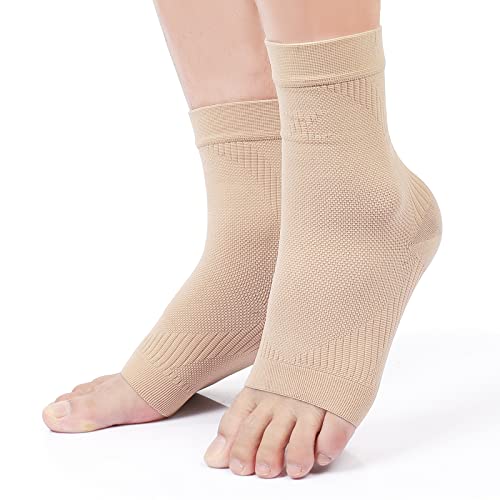
Graduated compression means the sleeve is tightest at the foot and looser as it climbs the calf, encouraging venous return (blood flow back toward the heart) and reducing pooling in the ankle. The KEKING Ankle Brace Compression Sleeve runs at 20 to 30 mmHg, a pressure range you usually see in medical-grade stockings, and supports the arch and heel as well as the joint itself. Where the Sleeve Stars options earlier spread their attention across several symptoms, this one leans into the circulation story.
Soccer players who finish a session with a hot, heavy ankle tend to notice the difference between a uniform sleeve and one that actually squeezes harder at the bottom. On long tournament weekends, that pressure gradient keeps the joint from ballooning between matches.
Useful Highlights
- Graduated 20-30 mmHg compression supports venous return
- Targeted knit stabilizes arch and heel in one piece
- Useful across plantar fasciitis, Achilles, and ankle swelling
- Slim enough to wear under a soccer sock without excess bulk
Less Ideal Details
- Higher compression can feel restrictive during the first wear
- Knit may run warm in summer climates
- Pull-on strength is more than a typical sleeve, harder on arthritic hands
Perfect Match For
Athletes who finish matches with a swollen, heavy ankle and want a sleeve that actively drives fluid back up the calf.
Another Choice May Suit
You need a brace you can wear during scrimmage without the calf pressure, in that case the Z ATHLETICS Reinforced Lace Up Ankle Brace fits the bill.
Some ankles need more than a sleeve or a fabric lace-up. The ZAMST A2-DX Ankle Brace for Heavy Sprains is built for the serious end of the spectrum: Grade III sprains where the ligament has a complete tear, and chronic instability where the joint gives way on uneven ground. Side stabilizers (rigid plastic stays running along the medial and lateral sides of the ankle) resist inversion and eversion, the two motions that cause most soccer sprains, while the lace-up front lets you set the tension. It’s sold in three sizes for the right foot, so getting fit right matters.
Most users will not need this level of hardware. But for the one in five players who re-sprain within a year of the first injury, the rigid side stops buy back the confidence that fabric alone cannot restore.
The Practical Payoff
- Rigid side stabilizers block inversion and eversion at the joint line
- Adjustable lace-up front customizes compression across the dorsum, the top of the foot
- Specifically designed for Grade III sprains and chronic instability
- Multiple sizes for the right foot improve fit accuracy
Potential Drawbacks
- Bulk makes it harder to fit inside low-cut soccer boots
- Higher price tier than sleeves or fabric lace-ups
- Right-foot-only sizing means two purchases if both ankles are involved
At A Glance
Whose Shelf It Belongs On
Players recovering from a complete ligament tear or repeated giving-way episodes who need mechanical stops, not just compression.
Reach For A Different Pick When
You’re past the acute phase and want something breathable for daily training, the KEKING Ankle Brace Compression Sleeve handles that shift.
If you rotate between soccer, basketball, volleyball, and running, a brace that travels with you across cleats, court shoes, and trainers saves a lot of re-buying. The Z ATHLETICS Ankle Brace with Side Stabilizers combines a lace-up closure with plastic stays on both sides of the ankle, so it lives between the fabric-only Reinforced Lace Up earlier and the much more rigid ZAMST A2-DX above. That positioning makes it the everyday multi-sport workhorse.
The brace markets itself across basketball, volleyball, running, and soccer recovery, which tells you its design priority is versatility. For athletes who don’t want a closet full of sport-specific supports, that’s a real plus.
Useful Strengths
- Lace-up plus side stabilizers blend rigidity with adjustable fit
- Unisex design suits both male and female players
- Marketed across basketball, volleyball, running, and soccer
- Mid-range bulk fits inside most athletic footwear categories
Small Limitations
- Less heavy-duty than the ZAMST A2-DX for severe cases
- Lace-up takes longer to put on than a pull-on sleeve
- Plastic stays can press against the malleoli during long matches
Built With In Mind
Multi-sport athletes who want one brace they can move between cleats, court shoes, and trainers without swapping hardware.
A Better Fit Elsewhere
You’re dealing with a fresh, acute injury and need cold therapy first, the Shock Doctor Ice Recovery Compression Ankle Wrap covers that early window.
Matching the Right Brace to Your Sprain Stage
Soccer sprains fall into three grades, and the right brace depends on which one you’re working through. A Grade I stretch of the ligament fibers usually settles in a week or two with rest, ice, and a light compression sleeve like the Sleeve Stars options above. A Grade II partial tear benefits from a lace-up or strap system that controls inversion, which is the motion where the sole rolls inward, such as the Z ATHLETICS Reinforced Lace Up Ankle Brace, worn during the return-to-run phase.
Grade III tears and chronically unstable ankles need mechanical stops that resist inversion entirely. The ZAMST A2-DX with its plastic side stabilizers fills that role, though most players only graduate to it after a clinician’s evaluation. A reasonable rule of thumb: if the brace feels supportive but the joint still gives way on uneven turf, the hardware is too soft.
Sprain Severity and Brace Tier
Pair the grade to the brace tier. Mild: pull-on compression sleeves for training confidence. Moderate: lace-up figure-8 systems with adjustable straps. Severe: rigid side-stabilized braces, sized correctly for the involved foot, used for the full return-to-play window.
Sport-Specific Demands to Weigh
Soccer puts lateral force on the ankle at speed, more so than linear sports like running. If you cut and pivot a lot, prioritize braces with side stabilizers over plain sleeves. Goalkeepers who land from jumps need more vertical compression, which favors graduated sleeves like the KEKING. Defenders who challenge for headers care more about rigid stops, since awkward landings drive most of their sprains.
Key Considerations Across These Picks
Mistakes Worth Dodging
Skipping the cold-therapy window in the first seventy-two hours is the most common error. A brace won’t undo the swelling that aggressive early icing would have prevented. Buying a rigid brace for a Grade I sprain is the second mistake: you’ll lose mobility you need to rehab proprioception and end up with a stiff, weak joint. Sizing by shoe size instead of ankle circumference is the third, braces that fit a size-10 foot perfectly can miss a size-8 ankle entirely.
When Paying More Pays Off
The step up from a $25 fabric sleeve to a $50 lace-up with side stays pays off the first time you plant hard on uneven turf and don’t roll. The jump to a Grade III rigid brace costs more again, but the value is in the second and third matches where chronic instability would normally re-sprain the joint. For one-season recreational use, mid-tier braces cover most needs. For chronic cases, the higher tier earns its keep through avoided re-injury.
Frequently Asked Questions
How long should I wear an ankle brace after a soccer sprain?
Most Grade I and II sprains benefit from bracing during activity for four to six weeks, while Grade III tears often require longer support under clinical guidance.
Can I wear an ankle brace inside my soccer cleats?
Slim lace-ups and graduated sleeves fit inside most cleats, but rigid side-stabilized braces typically require a half-size larger boot to feel comfortable.
Should I ice or brace first after a sprain?
Ice first, within the first seventy-two hours, then transition to a brace for compression and stability once swelling stabilizes.
Are lace-up braces better than slip-on sleeves for soccer?
Lace-ups offer stronger lateral control for cutting sports, while sleeves excel at all-day wear and proprioceptive feedback during non-contact training.
When can I return to full soccer training after a sprain?
Most mild sprains allow return within two to three weeks, moderate sprains around four to six, and severe tears require clinician clearance that often stretches beyond two months.
The Takeaway
Sprained ankles aren’t a one-brace-fits-all problem. Match the hardware to the grade, the stage of rehab, and the demands of your position, and you’ll protect the joint without over-restricting it. The eight options above cover everything from acute cold therapy to chronic-instability bracing, so pick the level that matches where your ankle actually is today, not where you hope it will be tomorrow.