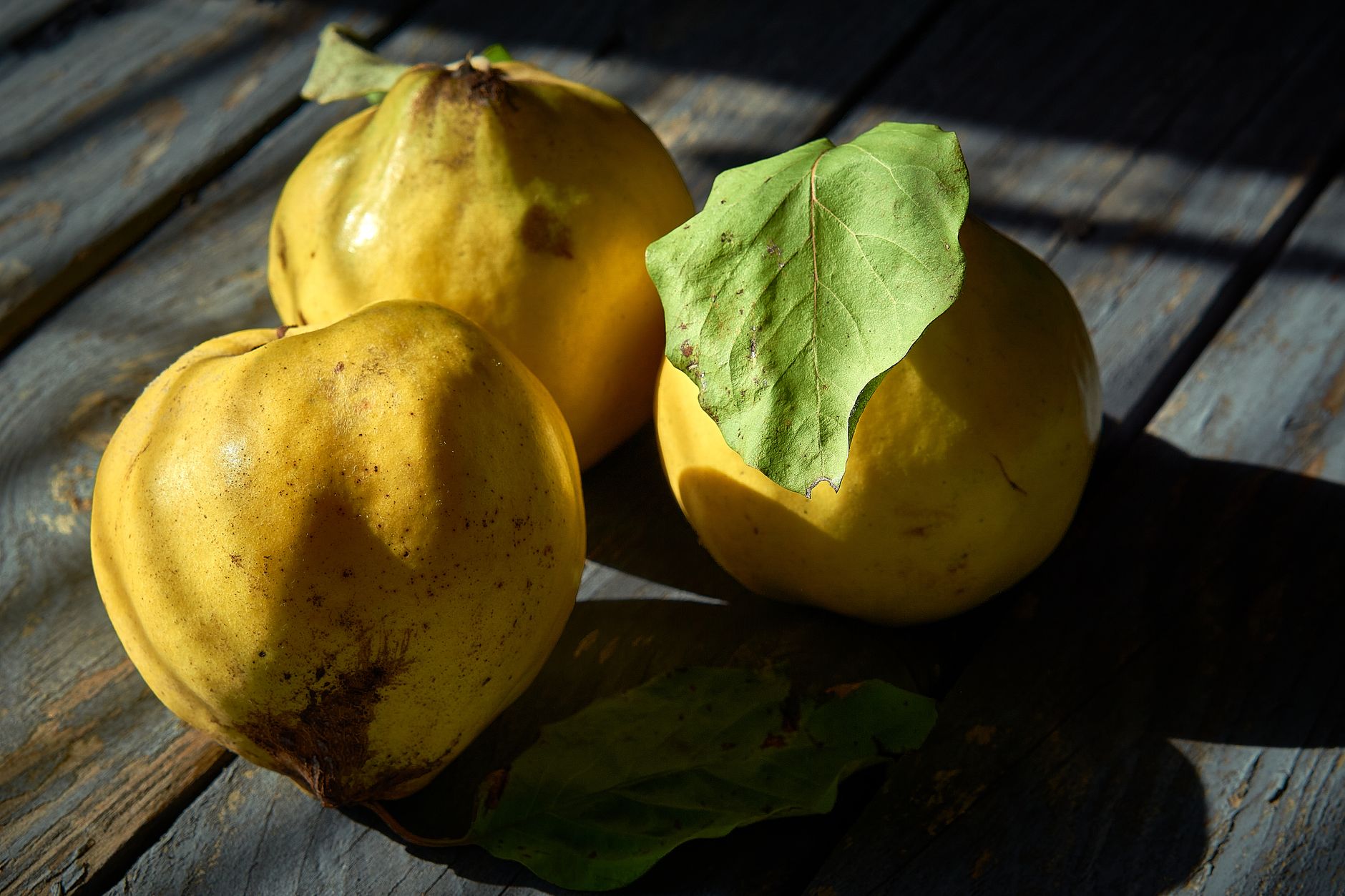

Quince benefits and nutrition center on a pome fruit, botanically Cydonia oblonga, that looks like a lumpy golden apple and behaves nothing like one in the kitchen. A single 92-gram raw fruit delivers roughly 52 calories, a meaningful dose of vitamin C, and a generous share of soluble pectin fiber that changes the fruit’s role once heat enters the picture. The astringency that makes raw quince almost inedible softens into a fragrant, floral sweetness after a long roast or slow poach.
This guide explores what makes the underappreciated quince worth seeking out, breaking down its nutritional makeup, researched health benefits, possible side effects, and practical tips for selecting and cooking the fruit at home.
The Ancient Pome Fruit Most Americans Have Never Eaten
Quince is a pome fruit, the same botanical category as apples and pears, which means it grows from a single fleshy core surrounded by a tough rind. The tree itself traces back more than 4,000 years to the Caucasus and ancient Persia, and it spread westward through the Mediterranean basin long before it reached the Americas. Greek mythology placed it on the wedding altar as a symbol of love and fertility, and Persian poets wrote about its perfume as a signal of autumn’s arrival.
Why It Stays Rare in US Stores
Commercially, the fruit thrives in Turkey, Iran, Spain, and Argentina, but US cultivation sits mostly in California’s central valley. Limited acreage, a short shelf life, and a customer base unfamiliar with how to cook it keep mainstream grocers from stocking it in volume. Your best bets in the United States are farmers’ markets in late September through November, Middle Eastern or Hispanic grocery stores, and online specialty retailers that ship when the harvest runs.
What a Quince Looks and Tastes Like
Ripe quince weighs roughly as much as a large apple but feels denser, with a fuzzy golden-yellow skin that can blush pink where the sun hit it. The flesh stays rock-hard even at peak ripeness, and the raw flavor leans intensely tart, woody, and mouth-puckering. That astringency comes from tannins, the same compounds that leave black tea dry on the tongue, and it softens into honeyed, rose-like sweetness only after prolonged heat.
Those same heat-driven changes also reshape the fruit’s nutritional profile, concentrating sugars while altering several key micronutrients.
| Trait | Quince | Apple | Pear |
|---|---|---|---|
| Shape | Irregular, lumpy, often lopsided | Round, uniform | Bell-shaped, tapered neck |
| Skin | Fuzzy, golden-yellow, pink blush | Smooth, red/green/yellow | Smooth, green or russet |
| Ripeness feel | Rock-hard even when ripe | Firm to soft depending on variety | Firm to yielding |
| Raw flavor | Astringent, tart, woody | Sweet-tart, crisp | Sweet, juicy, slightly gritty |
| Culinary role | Almost always cooked | Raw or cooked | Raw or cooked |
What a Single Quince Actually Delivers Nutritionally
The macronutrient picture is unremarkable on its own: about 52 calories per 92-gram raw fruit, less than 1 gram of protein, and trace fat. Carbohydrates drive nearly every calorie, and natural sugar concentration rises sharply as the fruit ripens from pale yellow to deep gold. Where the fruit earns attention is the micronutrient density and the specific type of fiber it carries.
Vitamin C and Pectin Stand Out
A 100-gram serving of raw quince delivers a notable share of the daily vitamin C target, often rivaling or outpacing many common apple varieties. The fiber runs high and leans toward pectin, the same soluble gel-forming carbohydrate used to set commercial jams. Cooking concentrates the pectin further, which is why cooked quince paste (membrillo) firms up into a sliceable block all on its own, no added pectin required.
Polyphenols and How Cooking Changes Them
Raw quince carries a polyphenol roster that includes quercetin, kaempferol, and chlorogenic acid, all studied for anti-inflammatory and antioxidant activity. Prolonged heat degrades some vitamin C, so a long-baked paste retains far less of it than a brief poach, but the polyphenol profile survives cooking better and may even concentrate as water evaporates. USDA FoodData Central lists the basic composition for raw quince and treats cooked values as estimates, since the category is small enough that detailed cooked entries remain limited.
| Per 100 g raw quince | Amount | Why it matters |
|---|---|---|
| Calories | ~57 kcal | Low energy density |
| Carbohydrate | ~15 g | Mostly natural sugars and pectin |
| Fiber | ~1.7 g | Soluble-heavy, supports digestion |
| Vitamin C | ~15 mg | Immune and skin support |
| Potassium | ~197 mg | Blood pressure balance |
| Polyphenols | Quercetin, kaempferol, chlorogenic acid | Antioxidant activity |
Evidence-Graded Health Benefits Worth Paying Attention To
Quince fruit health benefits split cleanly into two categories: those backed by human studies or strong traditional use, and those that live mostly in test tubes and animal models. Sorting them prevents you from mistaking laboratory promise for clinical proof.
Digestive Support and Cardiovascular Markers
Pectin’s gel-forming action slows gastric emptying and feeds beneficial gut bacteria, which is why quince has a long track record in traditional medicine for diarrhea, gastritis, and ulcer discomfort. Pectin also binds bile acids in the intestine, forcing the liver to pull cholesterol from circulation to make more, which over time can nudge LDL numbers downward. The potassium content adds a blood-pressure-friendly counterweight to sodium-heavy diets, although the effect is modest compared with medication.
Antioxidant, Immune, and Weight Effects
The polyphenol mix and vitamin C work together rather than alone: vitamin C regenerates oxidized polyphenols, and the polyphenols protect vitamin C from breaking down. That synergy shows up clearly in lab antioxidant assays, though human bioavailability data for quince specifically remains thin. For weight management, the low calorie density and high fiber satiety per serving make cooked quince a useful substitute for higher-calorie dessert bases, especially when you skip added sugar or lean on spices for sweetness.
That dietary flexibility matters less if the fruit itself poses risks, which is why safety deserves a careful look next.
Evidence snapshot: digestive and lipid effects sit in the “supported by human and animal data” tier. Anti-inflammatory claims lean on test-tube and rodent studies. Immune claims rest mostly on vitamin C content, which is real but not unique to quince.
Side Effects, Seed Safety, and Who Should Be Cautious
Quince is food, not medicine, and it carries the same common-sense limits as any high-fiber fruit eaten in excess. A few specific risks deserve attention because the fruit behaves differently from apples or pears.
Cyanogenic Compounds in the Seeds
Quince seeds, like apple seeds, contain amygdalin, a compound that releases trace hydrogen cyanide when chewed. Swallowing a few seeds whole during a bite of paste is harmless because the seed coat stays intact. Chewing large quantities of seeds, or brewing them into a concentrated tonic, is a different story, and traditional recipes that call for seed infusions use small amounts for short periods rather than daily doses.
Allergies, Digestion, and Medication Considerations
People allergic to apples or other Rosaceae fruits can react to quince through cross-reactivity, especially the oral allergy syndrome pattern of itching lips and throat. Eating underripe fruit, or large portions at once, can bring bloating and constipation in fiber-sensitive guts because the pectin draws water into the colon. High-fiber diets also slow the absorption of some medications, so spacing quince-heavy meals an hour or two from prescription doses is a practical move worth raising with your pharmacist or prescribing clinician.
Pesticide Residue and Sourcing
Quince falls outside the Environmental Working Group’s annual Dirty Dozen and Clean Fifteen rankings because so little is sold in the United States. Conventional orchards overseas use fungicides against fire blight, and imported fruit occasionally carries residue at the legal limit. Choosing organic when you can, peeling when you cannot, and rinsing under running water all reduce surface residue, but the bigger practical step is buying from growers who publish their spray records.
Selecting, Ripening, and Cooking Quince in a US Kitchen
The single biggest reason people dislike quince is that they eat it raw, where the astringency overwhelms everything else. Heat fixes that. A few minutes of planning turns the same fruit into something that tastes like a spiced pear crossed with a floral apple.
Where to Buy It
From late September through November, look for quince at farmers’ markets, Middle Eastern grocers (often labeled safarjal), and Hispanic markets (membrillo in paste form year-round). Online retailers like Melissa’s, Frog Hollow Farm, and a handful of Pacific Northwest orchards ship during the harvest window. Prices run higher than apples because supply is thin; expect to pay roughly $4 to $8 per pound in season, less for imported fruit.
Ripening and Storage Timelines
Leave firm quinces on the counter at cool room temperature for 5 to 10 days, or speed the process by placing them in a paper bag with a banana. Ripe fruit shifts from grass-green to deep golden yellow, the fuzz rubs off easily, and a gentle press near the stem yields just slightly. Whole ripe fruit keeps another 2 to 4 weeks refrigerated. Cut quince browns fast, so a splash of lemon juice in water preserves color for 3 to 5 days in the fridge.
Four Foundational Techniques
- Poach in syrup: Simmer peeled or unpeeled slices in equal parts water and sugar with a cinnamon stick and star anise for 40 to 60 minutes, until tender and ruby-pink.
- Roast whole: Halve and core, then bake cut-side down at 350°F for 45 to 60 minutes, until the flesh turns deep rose and a knife slides in easily.
- Slow-bake into paste: Simmer chopped quince with sugar and a splash of water for 1.5 to 2 hours, then bake the puree at 250°F until thick enough to hold a spoon, around 1 hour.
- Stew with savory dishes: Quince slices braised with lamb, duck, or pork shoulder absorb fat and balance rich meat with bright acidity.
Substitutions When Fresh Quince Is Out of Reach
A blend of tart green apple and underripe pear, cooked with extra pectin, comes closest to fresh quince in jam and paste recipes. Guava paste, sold in Hispanic markets as pasta de guayaba, mirrors the dense sweetness of membrillo on a cheese board. Dried quince, increasingly available online, rehydrates in warm water and works in tagines and pilafs, though it loses the color shift that makes fresh fruit so striking.
Those practical tradeoffs become clearer when quince is weighed directly against the fruits Americans already keep on hand.
Quince Compared With Apples and Pears on Every Practical Level
Apples win on convenience, pears win on juiciness, and quince wins on aroma and fiber per bite. Picking between them depends on whether you want raw crunch, a quick dessert, or a slow-cooked centerpiece that holds its shape through hours of heat.
| Per 100 g raw | Quince | Apple | Pear |
|---|---|---|---|
| Calories | ~57 | ~52 | ~57 |
| Fiber | ~1.7 g (high pectin) | ~2.4 g (mixed) | ~3.1 g (mixed) |
| Vitamin C | ~15 mg | ~4.6 mg | ~4.3 mg |
| Sugar at ripeness | Rises sharply late | Stable, variety-driven | Rises sharply late |
| Raw eatable | Rarely | Yes | Yes |
| Cost in US (per lb) | $4 to $8 in season | $1 to $3 year-round | $1 to $3 year-round |
Quince clearly outperforms apples and pears on vitamin C density and pectin content, and it holds its shape far better during long cooking, which is why pastry chefs reach for it. Apples still win for everyday snacking, school lunches, and any recipe where raw texture matters. Pears sit in the middle, juicier than quince and more fragrant than most apples, but without the same concentrated pectin or the dramatic color shift that turns a slow-baked quince paste deep rose.
A simple decision rule covers most cases: choose quince when you want a distinctive floral note, a fiber-rich cooked dessert, or a striking cheese-board centerpiece. Choose apples when convenience, cost, and raw crunch drive the choice. Choose pears when you need juice and a softer cooked texture without added pectin.
Bottom Line
Quince is a fiber- and vitamin-C-dense fruit that rewards patience, because the rock-hard, mouth-puckering raw form becomes something special only after a long poach or roast. Treat it as a seasonal specialty, source it from a market that stocks it in autumn, and pair it with cheese or slow-cooked meat for the most reliable payoff. Speak with a qualified clinician before leaning on quince, quince tea, or any seed-based preparation as a digestive remedy, especially during pregnancy or while taking prescription medication.
FAQ
What are the health benefits of quince?
Quince is rich in pectin and vitamin C, which support digestion, immune function, and lipid balance. Polyphenols like quercetin and chlorogenic acid add antioxidant activity, though most of the strongest evidence for anti-inflammatory effects comes from laboratory and animal studies rather than large human trials.
Is quince safe to eat raw?
Raw quince is not toxic, but its high tannin content makes it intensely astringent and unpleasant to eat out of hand. Most people cook it for 30 minutes to several hours, which softens the tannins and brings out the fruit’s floral sweetness.
Can quince help with digestion?
The pectin in quince acts as a gentle soluble fiber that can ease both constipation and diarrhea, and traditional medicine has used quince for gastritis and ulcer discomfort for centuries. Human data remains limited, so use it as a food-based support rather than a substitute for clinical treatment.
How much sugar is in a quince?
A raw 92-gram quince contains roughly 13 to 15 grams of carbohydrate, mostly as natural sugars that rise sharply as the fruit ripens from green to deep gold. Cooked preparations concentrate the sugars further as water evaporates, so portion size matters if you are tracking glucose.
What are the side effects of eating quince?
Side effects of eating quince are mild for most people and include bloating or constipation when portions are large, possible oral allergy symptoms in those sensitive to apples, and cyanogenic exposure from chewing large amounts of seeds. Pregnant or nursing people should consult a qualified clinician before consuming concentrated quince seed preparations.
How is quince used in traditional medicine?
Traditional medicine uses quince paste, syrup, and seed infusions for sore throats, diarrhea, and inflammation, with roots in Persian, Greek, and Ayurvedic practice. Modern evidence supports the fiber and polyphenol content but has not validated the stronger historical claims, so the fruit is best treated as supportive food rather than therapy.