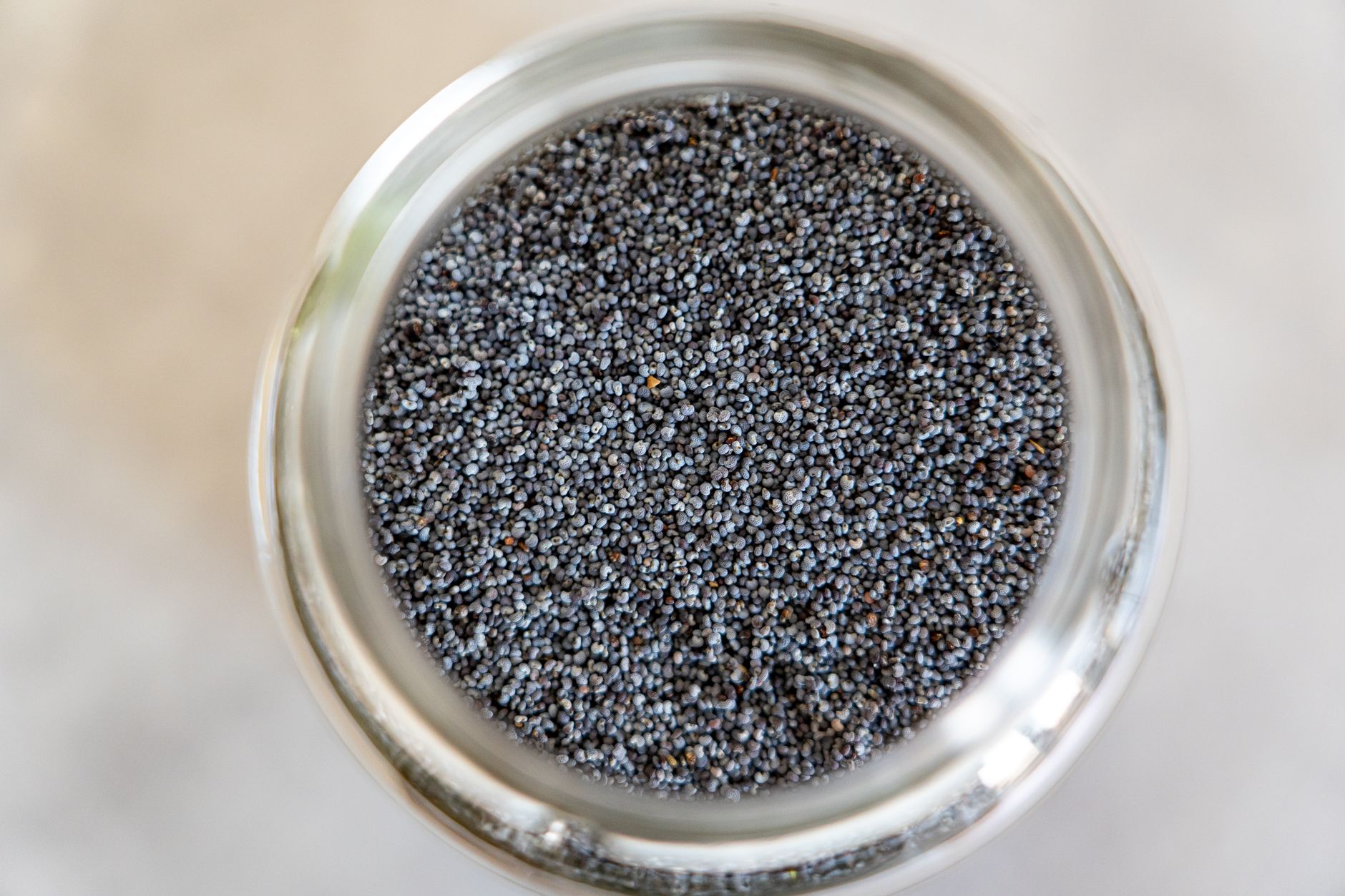

Poppy seeds nutrition refers to the dense mix of calories, fiber, protein, calcium, manganese, and unsaturated fat packed into the tiny, kidney-shaped kernels harvested from the dried seed pods of the opium poppy (Papaver somniferum). A single tablespoon delivers about 46 calories, 1.5 grams of protein, and 1 gram of fiber, alongside a mineral profile that runs unusually high for a seed this small. The catch is the trace morphine and codeine that can survive from pod to pantry in measurable amounts, which is why poppy seeds also come with a few real caveats.
This guide explores poppy seeds nutrition in depth, breaking down their mineral density, potential benefits, real safety concerns, and how to use them in everyday cooking.
The Tiny Seed With a Complicated Past
Walk past a bakery case and you’ll see them scattered across bagels, braided into strudel, pressed into Indian sweets, and swirled through lemon curd. Poppy seeds have decorated human food for at least 4,000 years, with traces found in Bronze Age settlements across Europe and the Middle East. They were food first, and only later became tangled up with the opiate question that still confuses people today.
The same plant, but a different part of it
Opium, morphine, and codeine are produced in the milky latex that oozes from cuts in the unripe seed pod wall. The mature, dried seeds themselves develop after the pod is spent, by which point the latex is mostly gone. Surface contamination can still rub off during harvest, which is why even food-grade seeds carry trace alkaloids. The plant is one and the same; the part you eat is the part least involved in opiate production.
Where poppy seeds are grown, and why it matters
India and the Czech Republic anchor global production, with Turkey, Hungary, and Australia close behind. Origin quietly shapes two things: flavor and alkaloid load. Czech and Hungarian seeds are typically washed more aggressively under European food-safety rules, which lowers residual morphine. Indian and Australian seeds, harvested from varieties bred for higher alkaloid content, often test higher on the same scale. The same tablespoon can vary several-fold in morphine residue depending on where and how it was processed.
Quick reality check: eating a poppy seed muffin won’t get you high. The morphine dose from food is far below any pharmacologic effect, but it can be high enough to flag a workplace urine screen if you eat a lot of seeds right before the test.
What a Tablespoon of Poppy Seeds Actually Delivers
Poppy seed nutritional value runs high for calcium, manganese, and fiber relative to seed size. The numbers below come from USDA FoodData Central and reflect typical dried seeds sold in the US.
Macronutrients and calories in plain language
A tablespoon (about 9 grams) gives you roughly 46 calories, 1.5 grams of protein, 1 gram of digestible carbohydrate, and just over 4 grams of fat. Most of that fat is unsaturated, with linoleic acid (an omega-6) leading, followed by oleic acid (the same monounsaturated fat that makes olive oil heart-healthy). Protein is modest compared with chia or hemp, but the amino acid mix is complete enough to complement grain-based dishes.
The mineral story most articles skip
Calcium is the headline. Per 100 grams, poppy seeds deliver around 1,430 milligrams of calcium, more than most hard cheeses and several times what you get from milk by weight. Manganese is the sleeper: a single tablespoon covers roughly 25 to 30 percent of the daily need for an adult. Iron, magnesium, phosphorus, and zinc all show up in meaningful amounts, with copper and selenium in trace but useful quantities.
How poppy seeds compare to chia, flax, and sesame
Different seeds solve different problems. The table below puts the four most common pantry seeds side by side on the metrics people actually care about.
| Seed (1 tablespoon, ~9–14 g) | Calcium (mg) | Fiber (g) | ALA Omega-3 (g) | Best for |
|---|---|---|---|---|
| Poppy | ~127 | ~1.0 | ~0.05 | Calcium, baking crunch |
| Chia | ~63 | ~4.1 | ~1.8 | Fiber, omega-3, thickening |
| Flax (ground) | ~22 | ~2.8 | ~2.4 | Omega-3, lignans |
| Sesame | ~87 | ~1.1 | ~0.04 | Calcium, Middle Eastern flavor |
Poppy seeds are the calcium champion of the group. Chia and ground flax dominate the fiber and omega-3 columns. Sesame lands in the middle, with a flavor profile that overlaps poppy in some savory applications. Picking the “best” seed depends entirely on what your diet is missing.
What the Evidence Really Says About Poppy Seed Health Benefits
Most online write-ups stretch the claimed health benefits of poppy seeds far past what the evidence actually supports. The honest version is shorter, but the seed still earns its place in a balanced diet if you use it for the right reasons.
Bone support, with realistic expectations
The calcium, phosphorus, and manganese in poppy seeds are all directly involved in bone density and bone matrix formation. Eating a tablespoon a day adds up to a meaningful slice of your daily calcium target over a month. To get the same calcium from milk, you’d need to drink roughly 300 milliliters (about 1.25 cups). The catch is absorption: the oxalates and phytates in seeds bind some of that calcium and limit how much your body actually uses. Think of poppy seeds as a calcium contributor, not a calcium replacement.
Digestion, satiety, and the fiber math
About 5 to 6 percent of a poppy seed’s weight is insoluble fiber, the kind that adds bulk and speeds stool transit. It’s modest compared with chia, but a tablespoon sprinkled on yogurt or folded into a salad dressing does add up across a day. Insoluble fiber also drives satiety, which is partly why seeded baked goods feel more filling than their plain counterparts. If constipation relief is a personal goal, poppy seeds won’t beat prunes or psyllium, but they help as part of a fiber-diverse day.
Heart and blood pressure, with honest hedges
Two mechanisms show up in the literature. The unsaturated fat profile (mostly linoleic and oleic acid) is the kind linked in larger dietary studies to lower LDL cholesterol. The potassium and magnesium content supports healthy blood pressure regulation, especially in people whose diets run low on both. None of this turns poppy seeds into a treatment. At typical intake levels, the heart benefits are a small contribution inside an overall dietary pattern rather than a standalone effect.
Where wellness blogs overreach
Claims that poppy seeds “cure insomnia,” “relieve pain,” or “detox the liver” trace back to the seed’s botanical cousin and its alkaloid reputation, not to anything measurable in the dried seed. Antioxidant content is real but small, and any specific antioxidant claim needs to be tied to a study, not a tradition. Use poppy seeds for the documented calcium, fiber, and unsaturated fat. Skip the therapeutic framing.
But the nutritional upside doesn’t address the reason most people hesitate: the drug-test issue.
The Opiate Question, Drug Tests, and Interactions Worth Taking Seriously
This is the section that decides whether the answer is yes for you. The risks are small for most people and significant in a few specific situations, so it pays to be precise.
Morphine and codeine content in plain numbers
Independent lab surveys of retail poppy seeds find morphine concentrations ranging from about 0.1 to 10 micrograms per gram, with codeine roughly one-tenth to one-third of the morphine level. A tablespoon (9 grams) of a high-residue seed can therefore deliver somewhere between 1 and 90 micrograms of morphine. Thebaine and papaverine show up too, but in smaller amounts. None of this is anywhere near a therapeutic dose, and none will make you feel sedated, but urine drug tests are calibrated to detect micrograms, not milligrams.
Drug test thresholds and the bagel problem
Workplace urine drug screening in the US follows SAMHSA’s mandatory guidelines, which set an initial screening cutoff of 2,000 ng/mL for codeine or morphine and a confirmation cutoff of 2,000 ng/mL. Eating a single poppy seed bagel (roughly 5 grams of seeds) can push urinary morphine above 1,000 ng/mL in sensitive individuals and above the 2,000 ng/mL threshold in some cases, especially within 2 to 6 hours of eating. Hydration, baking, and soaking all reduce the number, but none eliminate it. If a pre-employment or athletic drug test is on your calendar, switch to sesame or nigella seeds for at least 48 to 72 hours beforehand.
Drug interactions to flag with a pharmacist
The trace alkaloid load is too small to cause problems on its own, but combined with certain medications it can add up. Tell your pharmacist or prescriber if you eat poppy seeds regularly and you also take:
- Opioid pain medications (codeine, oxycodone, hydrocodone, morphine), since trace morphine can add a small but measurable load.
- MAOIs (phenelzine, tranylcypromine, selegiline), which can interact unpredictably with even low levels of opiate alkaloids.
- Sedatives and CNS depressants (benzodiazepines, sleep aids, some antihistamines), where poppy seed compounds can amplify drowsiness.
Allergic reactions and cross-reactivity
True poppy seed allergy is rare, but it does occur, with documented cases ranging from oral itching to anaphylaxis. People allergic to other seeds, to nuts, or to latex report cross-reactivity at higher rates than the general population. Start with a small amount if you’ve never eaten poppy seeds before and any of those apply to you.
Portion, Storage, and Cooking: Making Poppy Seeds Work in Real Kitchens
Poppy seeds calories and protein numbers stay modest, but the seeds behave differently depending on whether they’re whole, ground, blue, white, soaked, or toasted. A few practical details make the difference between a jar that goes rancid in the back of the pantry and one that lifts every dish it touches.
Portion sizes tied to real foods
Abstract tablespoon advice is hard to apply. A more useful framework is the actual seed load in common preparations:
- Everything bagel or seeded loaf: 1 to 2 teaspoons per bagel, well below any meaningful opiate load.
- Lemon poppy seed muffin: 1 to 2 tablespoons per dozen, so a single muffin carries under a teaspoon.
- Indian curry paste or khus khus paste: 2 to 3 tablespoons ground into a serving for 4, a common daily use across South Asian cooking.
- Salad dressing or topping: 1 teaspoon per serving, an easy way to add calcium without much calorie load.
For a general adult without a drug test on the horizon, a tablespoon or two a day fits comfortably inside a balanced diet. Higher culinary use (such as a poppy seed–heavy cake or paste) is fine for most people but worth pausing if you’re on opioids or MAOIs.
Blue, white, European, and Asian varieties
Blue (European) poppy seeds are the classic baking seed: small, dark blue-gray, with a nutty flavor that holds up in lemon and almond desserts. White (Indian or Middle Eastern, often sold as khus khus or posto) seeds are milder, slightly sweeter, and ground into pastes for curries, kormas, and kheer. Asian-grown seeds tend to test higher for residual morphine in published surveys, so they’re the ones to watch if drug tests are a concern. European seeds, especially those labeled “washed” or “cleaned,” carry the lowest residue on average.
Toasting, grinding, soaking, and blooming
Dry-toasting in a pan for 1 to 2 minutes deepens the flavor dramatically and is worth the small effort before sprinkling on salads. Soaking or blooming (covering seeds with hot water or milk for 10 to 15 minutes) softens them and is essential for pastes. Grinding in a small spice grinder unlocks the calcium and oils your teeth can’t break down on their own; the result is more flavorful and more nutritious than whole seeds in a dressing. Avoid grinding in bulk, since the oils oxidize quickly once exposed to air.
Storage science without the guesswork
Whole poppy seeds keep for 1 to 2 years in a cool, dark pantry because the oil is sealed inside the seed coat. Ground seeds lose flavor in 3 to 6 months as the unsaturated fat oxidizes. A few signs of rancidity to watch for: a paint-like or turpentine smell, a bitter aftertaste, or a sticky clump in the jar. Refrigeration slows oxidation, and freezing extends whole-seed life further, but only if the container is truly airtight. A simple rule: whole seeds in the pantry, ground seeds in the freezer.
A Clear-Eyed Verdict on Whether Poppy Seeds Belong in Your Diet
Poppy seeds earn a spot in a varied diet for the calcium, manganese, fiber, and unsaturated fat they bring, especially if dairy isn’t a daily habit. They’re inexpensive, shelf-stable, and add texture and flavor that other seeds can’t quite match in baking and Indian cooking.
Skip them or pause if a workplace or athletic drug test is imminent, if you take opioids or MAOIs, or if you have a known seed or nut allergy. For everyone else, a tablespoon or two a day, ideally from a washed European source, is a low-risk way to round out a balanced pantry.
Check the bag of poppy seeds already in your kitchen. If it’s been more than a year, or if it smells sharp, replace it. Stir a teaspoon into tomorrow’s oatmeal or yogurt, notice the texture, and you’ll know from there whether the seed belongs in your rotation.
FAQ
Are poppy seeds safe to eat every day?
For most adults, a tablespoon or two of poppy seeds a day is well within a balanced diet and unlikely to cause problems. The main exceptions are people taking opioid medications or MAOIs, those with a seed or nut allergy, and anyone facing an upcoming drug test, who should pause for 48 to 72 hours beforehand.
Can poppy seeds cause a positive drug test?
Yes, especially within a few hours of eating a seed-heavy food like a poppy seed bagel or large muffin. The trace morphine in poppy seeds can push urinary morphine above the SAMHSA cutoff of 2,000 ng/mL in sensitive individuals. Switching to sesame or nigella seeds for 2 to 3 days before a scheduled test is the safest move.
Do poppy seeds help with sleep or pain?
Dietary amounts of poppy seeds show no meaningful effect on sleep or pain in any reliable clinical study to date. The seeds contain only trace alkaloid residues, far below any pharmacologic dose. Claims to the contrary trace back to the opium poppy’s reputation rather than anything measurable in the food itself.
How much poppy seed is too much?
There’s no formal upper limit, but a practical ceiling for general use sits around 2 to 3 tablespoons per day. Going well above that mostly adds calories and fat rather than additional benefit, and it increases the chance of triggering a drug test or interacting with opioid medications.
What’s the difference between white and blue poppy seeds?
Blue poppy seeds are the small, dark seeds used in European and American baking. White poppy seeds, often labeled khus khus or posto, are the milder, slightly sweeter seeds used in Indian and Middle Eastern cooking, usually ground into pastes. Flavor and alkaloid residue both vary by variety, with European sources typically testing lower for morphine.